Is This Boulder Gaslighting Me?
Survey says: indoor climbing grades are basically vibes
One week I’m writing about doomed love stories and then it’s a blog about climbing.
Have a look at this WhatsApp convo from my bouldering crew:
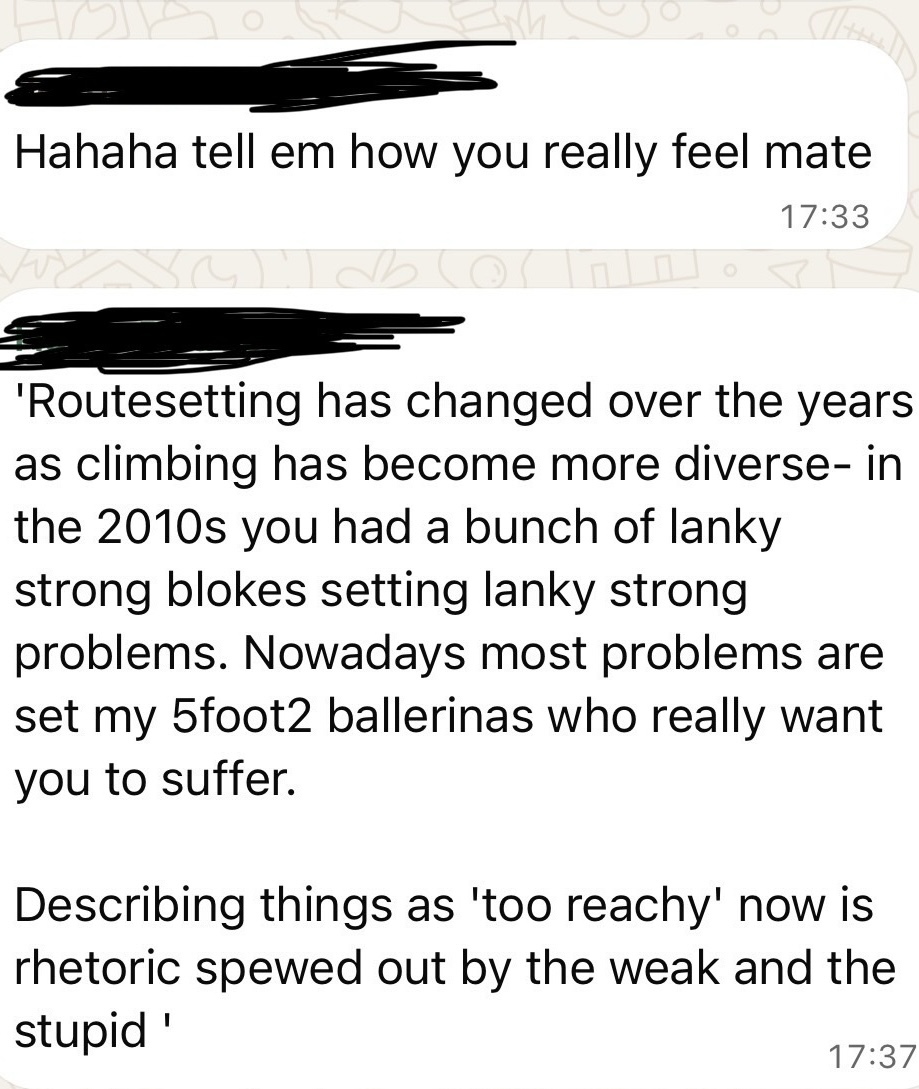
Feelings are running high.
“I’m too short!!” “Well, I’m too tall!!” “Just go up…” “Look, his arms are ridiculous, her fingers are tiny and the setter must be six foot five, this would definitely be around V4 if I had the wingspan.”
On cue, some kid comes along and flashes the problem anyway.
I’m weighing in, I don’t really think climbing walls are unfair, but climbing is the only thing where we assign a little number to something and feel inadequate about it (… oh)
Anyway, instead of writing up my opinion and calling it fact, I did something a little different this time. As I like to do in most areas of my life (taking something kind-of unimportant far too seriously), I made a survey.
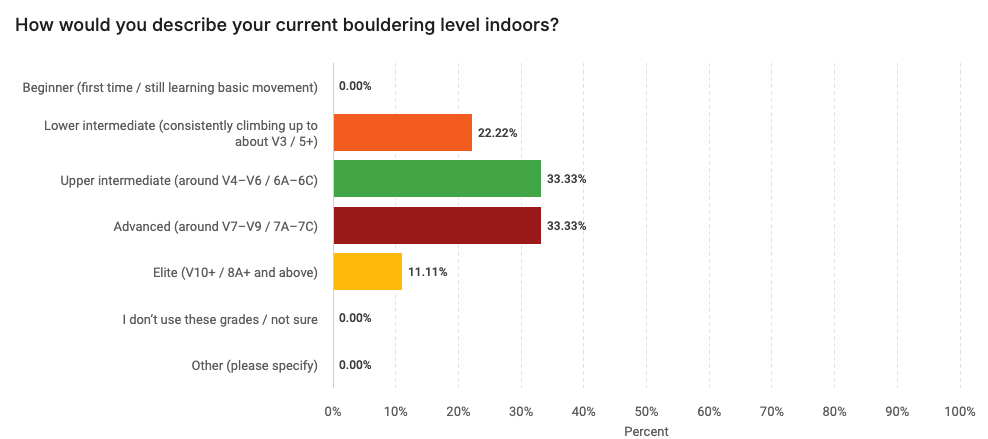
About thirty people answered (cheers Bloc crew et al). Most of the respondents were men (respect to the 5 women), leaning toward experienced climbers, and nobody was a complete beginner.
Everyone Thinks Height Matters
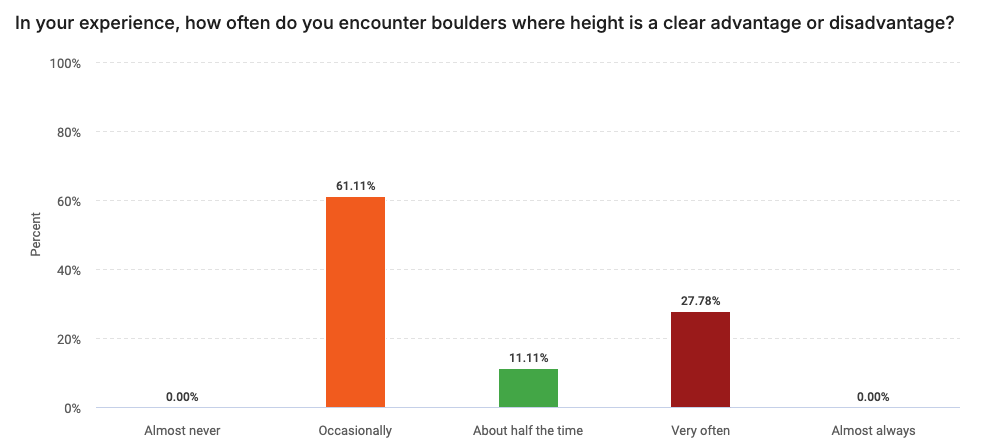
The obvious result is that nobody thought height was irrelevant. If one climber is 5’3 and another is 6’4, it would be silly if we concluded every sequence should feel identical.
But does that make indoor bouldering inherently unfair?
I’ll give it to you straight, when I compared people’s height with how fair they thought indoor climbing was overall, there was basically no relationship at all.
Being taller did not make you think climbing was fair, and being shorter did not make you think it was unfair.
Ok you have your basic answer, you can stop reading now, but if you want to dig a little deeper with me, keep going.
People seem to be actually much more bothered when the difficulty of a route changes depending on who was trying it. Naturally, the answer to that is to suck it up I’m afraid, but then again, we want climbing to be an inclusive sport don’t we?
It Isn’t Just Shorties Complaining
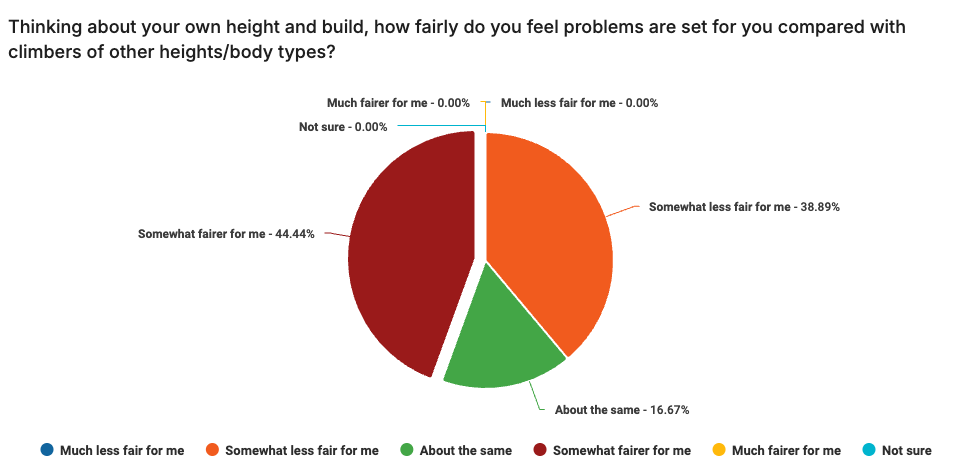
I asked people how fair they thought problems were for them personally at their local gyms, and the responses were almost perfectly split down the middle.
During cross-analysis, people who thought they benefited were not more likely to say climbing was fair overall.
Awww, you’re all so honest.
Basically, I don’t think anyone was using “fairness” as way of saying “this style is hard for me.” One tall person’s reply talked about how having extra reach can allow you to skip a difficult hold but being tall and heavy can make other styles considerably harder.

Height can be very useful when the crux is reachy, but a lot less so when the setter has folded you up like a pissed up game of Twister, a position I usually associate with the back seat of my old Mini Cooper.
So I guess the conclusion here is that “tall” and “short” are not really different difficulty levels built into our bodies. Any experienced climber will tell you that, but I still think there’s something here…
And as for this response, I offer no apology.

What About The Grades
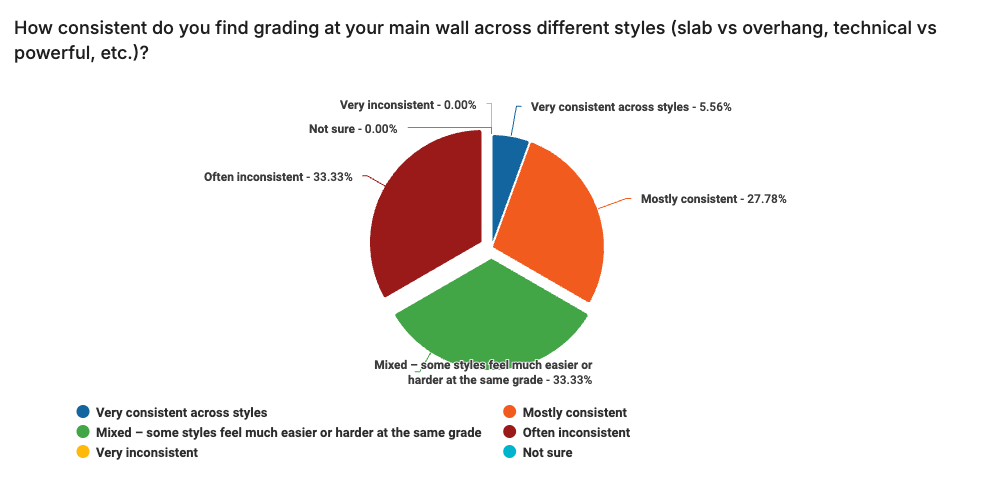
There’s your slab grade, your board grade, your gym grade, and then the frustrating as hell “easy problem” that isn’t easy at all. We all know grading is a mess, but when I asked people to rate individual styles, the disagreement became a bit clearer.
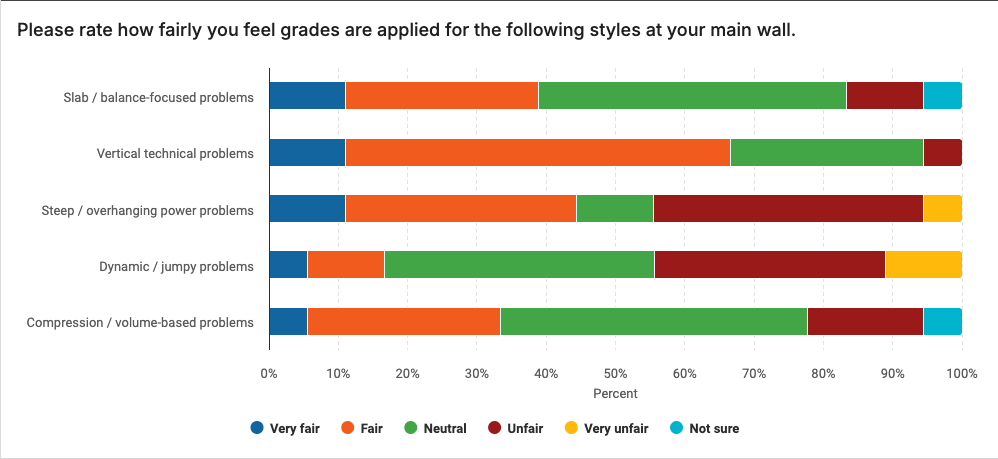
Vertical climbing was overwhelmingly seen as the most fairly graded, and perhaps unsurprisingly, dynamic problems came out last. The steep stuff split people almost exactly down the middle. That outcome surprised me, since the steeps at my local wall are always the hardest, regardless of grade.
We all know grade is supposed to communicate “something” adjacent to difficulty, and it doesn’t need to be perfect, but presumably a V5 is supposed to contain approximately “V5” amounts of difficulty. You know… whatever that means.
I’m deliberately not getting into the wider cultural debate around grading here. But if one style feels substantially harder or easier depending on somebody’s body, then the whole “grade thing” starts doing something kind of cool actually.
It seems like the modern grade is no longer describing only a (subjective) difficulty, it looks like it is describing a personal relationship between the boulder and the person climbing it too.
Dynamic Climbing Got Battered
Only 16% of people thought jumpy problems were fairly graded.
What’ve you guys got against the dyno, man?
I think this shows that dynamic movement exposes the weaknesses of subjectivity in grading more clearly than the other styles. A coordination move can feel very different given all of the morphological factors, and others, particularly confidence.
I’m sure we’ve all watched one person try a dyno for like forty minutes, then watch somebody else (perhaps even a “weaker” climber) walk over and cruise it.
How do you put just one number on that?
The Best Result Was Slab (Obviously)
You shorties absolutely love the slab!!
Every respondent below 180cm selected slab as one of their preferred styles, while only a tiny minority of the taller climbers did. Maybe I just know a large number of slab enthusiasts (freaks).
Still, our dimensions do not only affect whether you can reach the next hold.
They clearly also affect which types of movement feel satisfying, intuitive or enjoyable.
That isn’t really about fairness but I think it still helps paint the picture.
Maybe Grades Are The Problem?
I asked if people had anything else to say regarding fairness or grading. And I got some really nice and detailed responses.
… a lot of the time climbing is meant to be a challenge and I think people could and should tap into that curiosity about climbing movement and experiment more with what their body is actually capable of rather than being sucked into the grade of a boulder problem.
And,
(We need) A more even grade distribution, at present my wall as well as the bulk of others i visit tend to set a grade distribution in a bell curve fashion in which the majority of boulders are within the v3-5 range this leads to two frustrations with a few groups of climbers that I encounter.
One, stronger and weaker climbers that fall outside this bell curve often find themselves running out of boulders to complete with the bulk of routes being either too hard for beginners or too easy for advanced climbers to enjoy.
And two, often climbers attempting to break into the v6/7 range often struggle to find routes suited to their strengths while working on breaking into this grade range leading at times to frustration and the belief they are not ready to attempt the next step up in difficulty.
And yeah I agree (whoever you are), climbing is one of the few hobbies where you can spend two hours laughing with your friends, all whilst solving these little physical puzzles, and then you still leave the gym a bit annoyed because the coloured plastic had the wrong number next to it.
You know, if you think, “this is just an interesting problem,” then seeing your lanky mate soar up to the jug can be quite funny. Like my pal, who is literally half the height of the wall in some parts of the gym.
But then again, thinking: “this is objectively X grade and measures my current ability” then watching your tall mate skip the crux can feel like a failure. Likewise, seeing a shorter person fit into a tiny box when you can’t even start the climb has the same effect.
Either way, the end result can feel a bit like some kind of contract between ability and fairness has been broken.
So Is Indoor Bouldering Fair Then?
I hope we can all agree that different bodies solving problems in different ways is part of what makes climbing interesting.
What the albeit limited data shows is that “unfairness” begins to take hold when one physical thing allows somebody to bypass whatever it is that “makes” the problem that grade. Think: skipping a dyno because you’re tall or fitting into a box because you’re shorter.
What seems to bother people is when those differences make the climb stop making sense.
So the issue is not about different movement, it is different perceived challenge.
Perhaps, that means, for example, if the dyno can be skipped by a tall person, we need to be adding some ratty intermediates for the less bouncy folk? (Ideas like that came up a lot in the free text responses.)
I can feel the setters rolling their eyes. But the solution has to involve them. Nevertheless, I hope the takeaway from this piece isn’t that good setting means we have to make every climb equally suited to every possible human body. That sounds like an impossible task for the setters, and quite boring for us gumbies.
Good setting involves giving lots of different bodies enough different opportunities to feel strong, confused, challenged and totally useless, while making sure that over the course of the session everyone still feels confident enough to play around.

Apparently climbing is cool now, Vogue is writing about it. Even Louie V is selling chalk bags. Popularity has exploded over the last decade and we’ve gone from this fairly niche, geeky sport into a mainstream behemoth fronted by people like Alex Honnold.
So now that climbing has clearly moved on from the era of “strong blokes”, maybe the goal doesn’t have to be making every climb fair. It just has to make sure the unfairness moves from body to body and set to set, a bit like it does outdoors.